Project Narrative
Programme implementation was coordinated through a Programme Implementation Unit (PIU) under the MLHHSD that responded directly to the Permanent Secretary. Land Equity International (LEI) was contracted as the Program Management Company (PMC) providing key technical assistance and advice to the PIU.
Tanzania’s Development Vision 2025 aimed to transform Tanzania into a middle-income country by 2025, with its citizens enjoying high quality livelihoods and living in a peaceful, stable and unified country. In this vision, Tanzania would be a competitive economy capable of producing sustainable growth and shared benefits, characterised by good governance and a well-educated population. To achieve this vision, Tanzania’s agricultural sector needed to be more productive and profitable (resulting in higher farmer incomes), by enabling farmers to have better access to, and use of, agricultural knowledge, technologies, marketing systems and infrastructure. Good quality, private investment is seen as key to promoting growth and the development of a more competitive economy. At the same time, Tanzania’s national land policy and legal framework seeks to ensure that existing land rights are recognised, and security of tenure for all is upheld through an efficient, effective, economical and transparent system of land administration.
One of the key mechanisms for determining tenure arrangements in Tanzania is the division of land into three categories: village land, reserved land, and general land. The title for a right to occupancy on general land is called the Certificate of Right of Occupancy (CRO), and the title for rights to village land is called the Certificate of Customary Right of Occupancy (CCRO). Village lands may be leased or subleased, per the Village Land Act No 5 of 1999 (Section 19).
The Programme aimed to build a basis for resolving issues that constrained the contribution that Tanzania’s land sector could make to achieve the country’s broader development goals by establishing a road map for long-term support to the land sector that contributed to implementing the revised Strategic Plan for Implementation of Land Laws. At the same time, the Programme aimed to achieve concrete results during the three-year period to make significant contributions to improving the transparency and efficiency of land governance and administration. The Programme envisaged three areas of activities:
- enhancing transparency and benefits of large-scale land deals through providing information on land tenure and possible benefit-sharing models
- policy and institutional development to reach consensus on interpreting and implementing the existing legal and policy framework, clarify institutional roles and mandates, improve institutional interaction and improve dispute settlement procedures, and
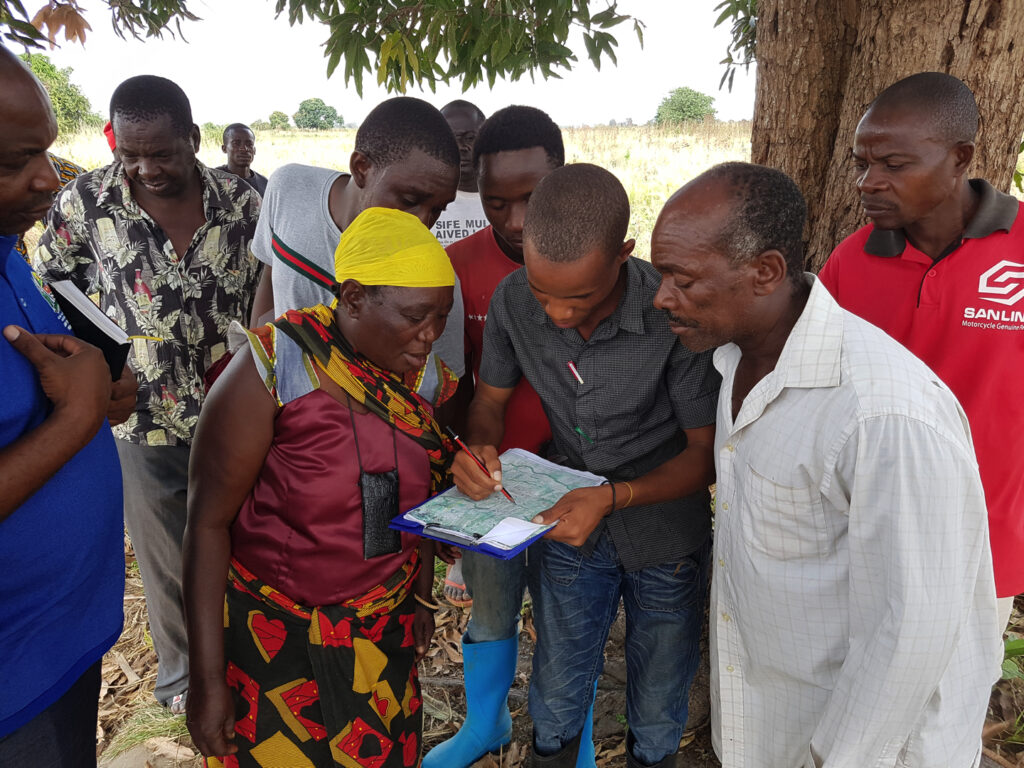
- land tenure regularisation in two pilot districts – based on a refined, low cost methodology to issue CCROs and more accurate information.
These areas were accompanied by two sets of cross-cutting and on-going activities focused on promoting consultation and oversight of the reforms in the land sector, and raising awareness of roles, responsibilities and procedures among central and local government officials, investors and villagers. Alongside these scheduled activities, the MLHHSD proposed that an unallocated flexible fund be provided under the Programme to finance unforeseen activities that were core to the Programme’s success that arose during the course of the Programme.
Key services provided
The main objective of the Programme was to deliver a road map for more transparent and accountable land governance, and effective land administration systems in Tanzania that will make a significant contribution to securing legitimate tenure rights, particularly for the rural poor, women and the vulnerable and increasing incomes and jobs.
LEI provided advisory services to the Programme Implementation Unit (PIU) to support the implementation of the LTSP. Four senior technical advisers provided services to:
- support the PIU to implement the Programme (by way of coordination, planning, organisational development, budgeting and reporting)
- assist with strategic programme planning and overall analysis of results, lessons learnt and their documentation and;
- lead, guide and supervise the Technical Assistance Team to ensure work was performed in accordance with agreed plans.