
Project Narrative
The Lesotho Land and Gender activity (L&G Activity), supported the Lesotho Millennium Challenge Account-II (MCA-Lesotho II) to meet the objectives of the Market Driven Irrigation Horticulture (MDIH) Project within the Lesotho 2 Compact. The MDIH project aims to increase rural incomes related to commercial horticulture, including for women, youth and the rural poor, and to establish a sustainable and inclusive model of irrigation, water and land resource management. It involved the construction of irrigation infrastructure and the attraction of commercial farmers to collaborate with local smallholder farmers to produce high-value crops and build strong value chains in four scheme areas – Tsoili Tsoili, Manka, Likhakeng (all three in Leribe District) and Phamong (Mohale’s Hoek district). To this end, the MDIH Project was dependent upon the identification of one or more commercial anchor farmers. Specifically, a key condition prior to working in the four schemes and construction of the irrigation infrastructure was that the MCA-Lesotho II identified a commercial investor (i.e. anchor farmer) willing to invest in the irrigation scheme.
Key Services Provided
The L&G Activity worked at two levels to support the MDIH Project. First, it supported the institutional reforms and gender-related aspects of the MDIH project to ensure that strong legal and policy frameworks are in place to facilitate the growth of irrigation throughout the country in an equitable and sustainable way. Within this framework, the L&G Activity provided inputs to the Rural Land Registration System (RLRS) at the national, regional and local levels so that rural land market participants, including land allottees of irrigable land under schemes, could vobtain registered land leases in an efficient, fair and cost-effective manner, and that these processes were fully reflective of gender equity under the law, including new gender reforms.
Second, the L&G Activity supported action within the scheme once the condition precedent has been met for that scheme (i.e. the identification of an anchor farmer). Specific actions included technical assistance and support to Community Councils in identifying landholders within the irrigation perimeter, confirmation of rights to land through development of a land survey, design of land use planning, design of a gender-sensitive programme to support landholders to decide how they want to use irrigated land parcels . Much of this work at the Scheme level was undertaken to be coordinated with two other MDIH Consultancies – the Resettlement and Livelihood Services (RLS Consultancy) and the Transaction Advisor. The Transaction Advisor supported the formation of legal agreements for use of land and agricultural production between smallholder farmers, land holders and commercial investors whilst the RLS Consultancy supported resettlement and compensation requirements for those that opt-out of participation in the irrigation scheme.
The L&G Activity was led by Land Equity International (LEI), in collaboration with three Lesotho organisations – the Lesotho-organisations RSDA, Gender Links and SI Futures – and the international consultancy firm Tetra Tech. It was designed as a 5-year project and commenced on 10th May 2024 . However, due to the US cancellation of the Lesotho-II Compact, the L&G contract was terminated on 19 December 2025.
Prior to the US Government Stop Work Order in February 2025 and the termination of the Compact, the L&G team achieved important results, particularly in the first scheme area, Phamong. The results achieved for the initial period of the project included :
- Development of a Stakeholder Engagement Plan for the forthcoming L&G interventions
- Design of a new RLRS information technology system to reflect changes in rural land laws;
- Design of a standard digital land allocation applications and land allocation confirmation certificates for the RLRS
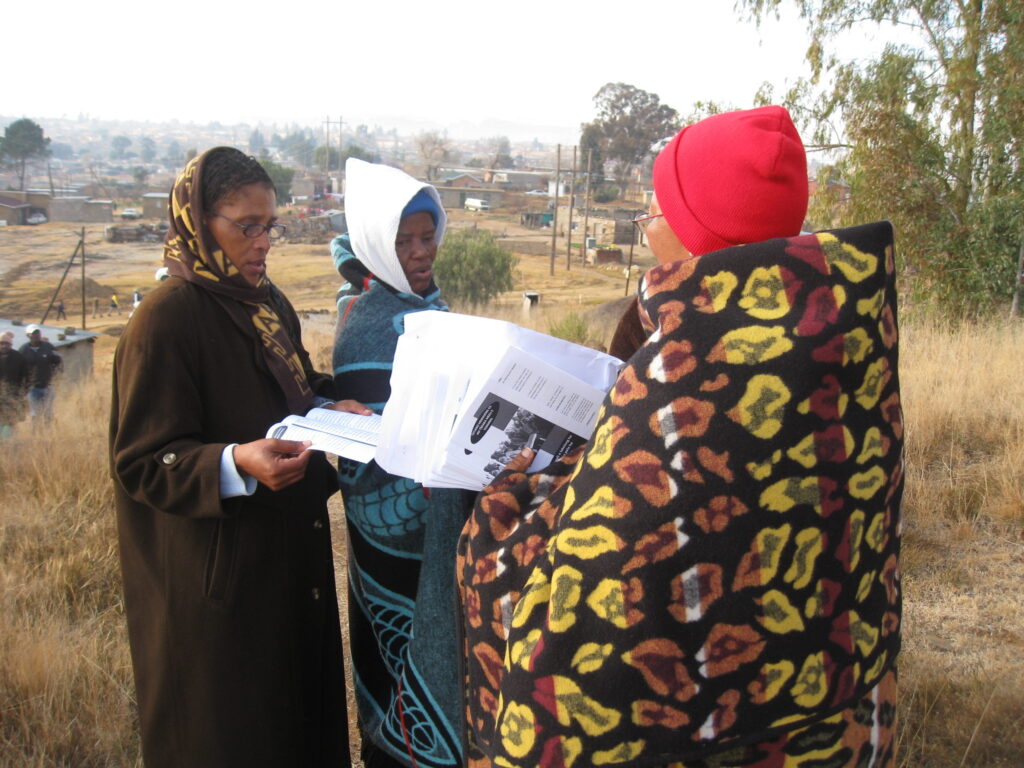
- Development and implementation of a programme of community outreach and social norm change to support gender-responsible land registration in the scheme area – this included community engagement applying the interhousehold Gender Action Learning System (GALS)
- Development and oversight of a land registration survey to identify landholders within the scheme areas.
- Design and hosting of validation workshops on the implementation a gender-sensitive land administration system, reflecting rights to equal inheritance among daughters and sons.
- Design of a safeguards and referral system to support reporting and access to remedies for victims of violence linked to land rights claims
- Research and recommendations around appropriate fees to pay for land services and land registration.
- Research and recommendations for a fit-for-purpose community mediation strategy in the case of disputes over land
- Field and desk research around social norm and market barriers preventing women and men to engage in collective irrigated agriculture and the development of strategies to address these in scheme areas (“Scheme Decision Making Plan”).
