
Project Narrative
The Mekong Region Land Governance project provides an ongoing platform for dealing with the continuing land challenges in the region. Recent studies found that there is an increase in the inequality in land distribution, this is illustrated by a reduction of small holders land holdings size on one side, and a large proportion of agricultural land given in concessions on the other side, resulting in a boom in commodity/ export crops. Contrary to current perceptions of high urbanisation rates, farmers remain the majority of population in each project country., Cambodia, Lao PDR, Myanmar and Vietnam. The agrarian transition may be on its way but is far from complete. A State of Land Report researched and produced during Phase 1, found that “rural to rural migrations are higher than rural to urban ones. The creation of employment in secondary and tertiary sector is not sufficient to absorb the work force coming out of agriculture. This also results in growing cross country migrations. This means the demand for agricultural land is increasing, and explains some of the drive of farmers towards upland areas.”
In this context and with a need to focus project efforts, MRLG Phase II continues from project work that began in March 2014. The first phase was characterised by its investigatory and exploratory approach towards achievement of the overarching project goal. Where as, Phase II is designed for a more strategic and politically informed approach. This will support the strategic engagement of Reform Actors in the policy making processes at national, sub-national and regional levels in a more deliberate and purposeful manner – leading to improved policy and practice implementation.
Phase II of the project started on 1st October 2018 due to continue for a further four years. LEI continues to co-implement this phase with Gret, Professionals for Fair Development.
Key services provided
The project objective of MRLG Phase 2 is: Improved policies and practices implemented in Cambodia, Lao PR, Myanmar and Viet Nam.
To achieve this objective, MRLG Phase II will devote its time, efforts and resources to three outcomes:
Outcome 1:
Reform Actors and networks engage strategically in improving policy and practice, regionally and nationally
The reform actor alliances will identify proper channels for policy dialogue, and develop adequate messages based on existing evidence, new evidence or pilot activities to influence policies and improve the implementation of policies. To influence changes in practice the alliances will target the appropriate stakeholders/ decision makers and tailor messages/learning approaches to ensure that the improved practices can be up-scaled.
Outcome 2:
Evidence-based options for improved policy and practice are available, regionally and nationally
The identification, documentation and/or development of policy and practice options (the production of good ideas) leading to increased smallholders security.
Outcome 3:
Channels for policy dialogue are identified or established, and utilised, regionally and nationally
The identification or establishment and use of channels and appropriate fora in which policy options can be presented, discussed, and understood by individuals and/or organisations key to policy decision-making in the public or private sectors.
The key difference and innovation of MRLG project is that it has developed a program that works with and supports multi-stakeholder alliances to achieve its objective. The alliance members are from existing organisations in the region, and thus considered a stronger and sustainable avenue for continued reform beyond the life of the Swiss funded project. While MRLG can and will in some cases act alone to contribute to either outcomes 2 or 3, it is deemed more effective if integrated by the reform actor alliances in their strategies and plans of actions under outcome 1.
A Theory of Change will be developed for specific work streams at national and regional level across the 4 countries to support responsible agricultural investment and the recognition of customary tenure promote smallholder access and tenure security. Activities will be initiated through the work streams to develop capacity of reform actors and the effectiveness of alliance activities to influence policy development and reform practices of land governance.
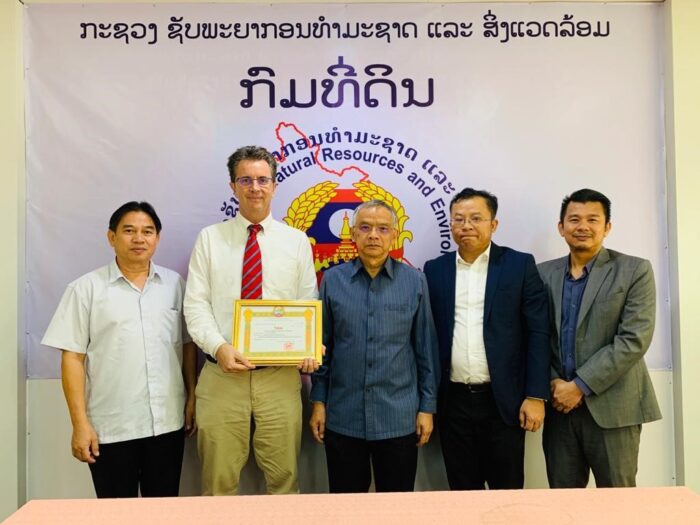
Certificate of Appreciation awarded to John Meadows for his leadership contribution within the Lao PDR project component of MRLG during 2017 – 2020.
