
Project Narrative
This project is a World Bank/AusAID co-financed project. The overall goal of the project is to strengthen the basis for long-term sustainable economic and social development. In conformity with this goal, the objectives of the project are to foster the development of efficient land markets and to facilitate domestic resource mobilization by providing a system of clear and enforceable land use ownership rights, and by developing a land valuation capacity. The project supports the first seven years of a longer term national land titling program (which is being developed during implementation) aimed at extending secure land ownership and developing land administration and valuation systems, including compiling a cadastral mapping system. The main components of the project are: (a) completion of the policy and legal framework for land management and administration (US$0.4 million); (b) implementation of an accelerated land titling program (US$19.0 million); (c) improvements in infrastructure, facilities and systems for land administration (US$2.7 million); (d) improvements in land valuation (US$0.8 million); (e) support for project management and implementation, and institutional strengthening (US$4.0 million); (f) studies on community land tenure and registration, definition of forest boundaries, cost recovery, land rights issues on nationalized lands and socio-economic impact (US$0.6 million)
Key services provided
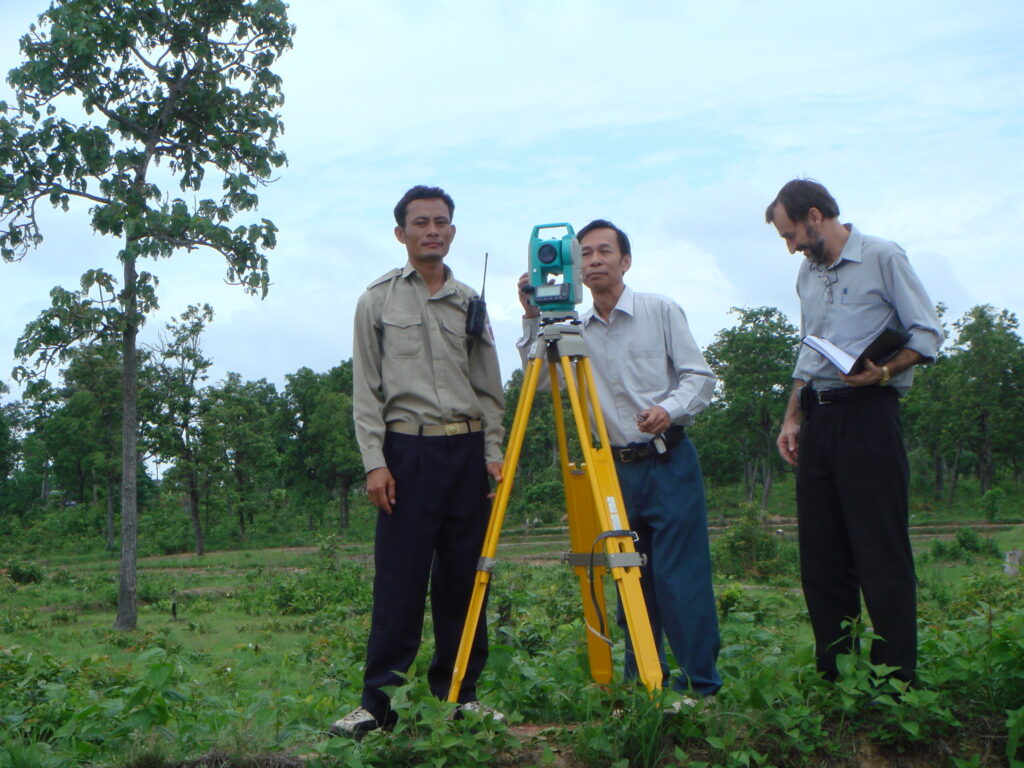
The TA assisted the successful implementation of LLTP in a total of nine provinces, these being Vientiane Prefecture, and provinces of Savannakhet, Champassack, Vientiane, Luang Prabang, Khammouane, Bolikhamsay, Sayaboury and Saravan. In the six years of the Project there were a number of major sector outcomes, which can be summarised as:
- The establishment of a Higher Diploma in Surveying and Land Administration at the Polytechnic School
- Improved governance through a gradual shift in DoL responsibility to a decentralised project management with a focus on the Land Office as the primary service delivery point for land administration.
- The introduction of a transparent systematic registration program (access to records, fees, participation etc).
There have also been a number of significant outputs which underpin the above outcomes, such as:
- Promulgation of a new Land Law on 31 May 1997.
- Development of legislation to enable systematic registration and valuation. The main pieces of legislation are: First time issuing of land titles by the method of Systematic Adjudication (MD 997/MoF)First time issuing of land titles by the method of Sporadic Adjudication (MD 998/MoF)Keeping the land title system up to date by a system of land parcel registration (MD 996/MoF)The Ministry of Finance has issued a first ever regulation on land and building valuation (1677/MoF)The Ministry of Finance has also issued a Ministerial Direction for cadastral surveying (748/MoF)
- The registration of in excess of 120,00 land parcels and the adjudication of in excess of 175,000 land parcels;
- The acquisition of 3,200 photomaps at scales of 1:1,000, 1:2,000 and 1:4,000 using digital technology that was new to Lao PDR;
- The development of a new geodetic datum for Lao PDR;Completion of a two-year Masters in Land Administration at the University of New South Wales by three government officials;
- The graduation of all 26 students from the In Country Course run at the Polytechnic School;
- Training of 660 staff (government and contract) in systematic registration;
- The Valuation Information System (VIS), in both manual and computerised format, has been developed and established in Vientiane Prefecture and the provinces of Luang Prabang, Savannakhet and Champassack. It provided an equitable and transparent system for the determination of taxes and charges based on land transactions and a foundation for increased GoL revenue generation.
- Completion of a civil works program that included the construction or renovation of 9 provincial land office buildings and the commencement of a new office building for the central Department of Lands;
- A Social Assessment Survey designed to evaluate the impact of the systematic registration certification program at a community level;
- An Existing Land Tenure and Forest Lands Study designed to contribute to the investigation of undertaking systematic registration in rural areas.
- A Socio-Economic Baseline Study designed to develop data from which the impact and benefits of the project can be measured;
- Development of computer software – Parcel and Land Use Registration Information System (PLURIS) for use by the Systematic Adjudication Teams (SAT).
