The challenge
Across Cambodia, Laos, Myanmar and Vietnam, forests and farmlands are under growing pressure. As the demand for agricultural commodities rose and commercial interests in land grew, Millions of smallholder farmers – many from ethnic minority communities whose rights to land existed in custom but had never been recognised in law – were left exposed to claims over the land that they depended on.
The Mekong region is home to around 300 million people, including some 70 million Indigenous people and members of local communities, for whom land and forests are the foundation of livelihoods, identity and security. With roughly 145 million people living in rural areas and highly dependent on agriculture, secure access to land is imperative. Yet the rights of smallholders, ethnic minorities and customary users are often weakly recognised and easily displaced.
Lasting change in this context cannot be engineered from outside. It depends on local reform actors who have the evidence, the relationships and the standing to shift policy, and the capacity to see those reforms through to implementation.
Our approach & role
For more than a decade, LEI worked with Gret to lead three consecutive phases of the MRLG project. The approach was deliberate: bring governments, communities, civil society, researchers and the private sector together around shared evidence, then support those alliances in shifting policy and practice across the region.
Building on the relationships, trust and credibility built in the project’s previous years, Phase III strengthened the national and regional alliances and shifted the emphasis from generating evidence to putting it to use, supporting implementation, scaling what worked, and embedding capabilities designed to outlast the project itself.
MRLG worked through an alliance-based model, bringing together more than 80 institutions from government, civil society, the private sector and academia – alliances that continue to serve as platforms for carrying the work forward. Within this model, our team’s contribution focused on:
- Governance, policy and institutional strengthening: helping reform actors engage in national, sub-national and regional policy processes.
- Capacity building: ensuring that land professionals, officials, and community members had the right tools and skills to carry these reforms into the future.
- Gender, community and inclusion: ensuring that women, ethnic minorities and other marginalised groups shaped and benefited from the reforms.
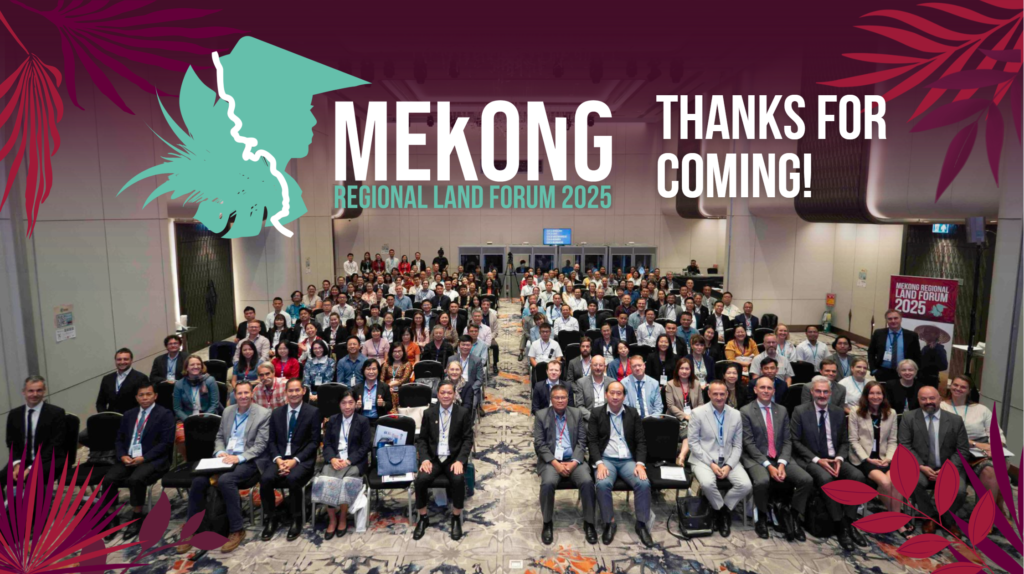
- Generating and sharing research and knowledge: building the evidence base for practical, adoptable policy options and creating opportunities for regional knowledge exchange such as the Mekong Regional Land Forum series.
Results & impact
By the end of its three phases, the project had benefited 38.5 million smallholder farmers through more than 40 legislative and policy reforms, and directly documented the rights of more than 149,000 farmers across the region.
Beyond the numbers, MRLG’s most durable legacy is institutional. Phase III leaves behind capable, well-connected alliances of reform actors able to keep influencing land policy long after the programme’s close, and a body of tested, evidence-based approaches that governments and partners have begun to adopt and scale. By keeping customary tenure, responsible agricultural investment, gender and climate resilience at the centre, the programme helped change not only specific policies, but the way land governance decisions get made across the region.
Recognising customary tenure
MRLG helped give legal recognition to land and forest rights that communities had held for generations but that the law had never acknowledged. In Laos, National Assembly Resolution 57 (2024) and Prime Minister’s Decree 20 (2025) recognised tenure rights in state forest areas – land that had previously been legally ambiguous for decades. In Vietnam, a revised Land Law (2024) strengthened the rights of ethnic minorities and gave citizens a formal right to monitor how it is applied. Regionally, ASEAN members approved the Guideline on the Recognition of Customary Tenure Rights in Forest Landscapes (2023) and a Handbook on Free, Prior and Informed Consent (2024). In Myanmar, MRLG sustained a civil society platform for tenure recognition through the ongoing conflict.
Responsible agricultural investment
The programme worked to make investment serve communities rather than displace them. In Laos, MRLG co-chaired the inter-ministerial Task Force on responsible investment and helped shape the Investment Promotion Law (2024) and Contract Farming Decree (2025). In Vietnam, it supported the Decree on Agricultural Land Accumulation and Concentration; in Cambodia, a Contract Farming Law due in late 2025.
This agenda continued in the related Transformative Land Investment project, extending the approach into regenerative agriculture and more inclusive food systems for family farmers in Laos and Myanmar.
Embedding gender and inclusion
MRLG built gender equity, climate adaptation and social inclusion into all its work, rather than treating them as add-ons. Gender equality was written directly into Vietnam’s 2024 Land Law; in Cambodia, women were two-thirds of participants in some community resource-mapping; and in Laos a women’s land rights toolkit was piloted and women appointed to local land-governance bodies. A regional Community of Practice on Gender and Land Governance was set up to carry these gains beyond the project.